
How Many IVF Cycles Are Needed ? | Lavanya Fertility Centre
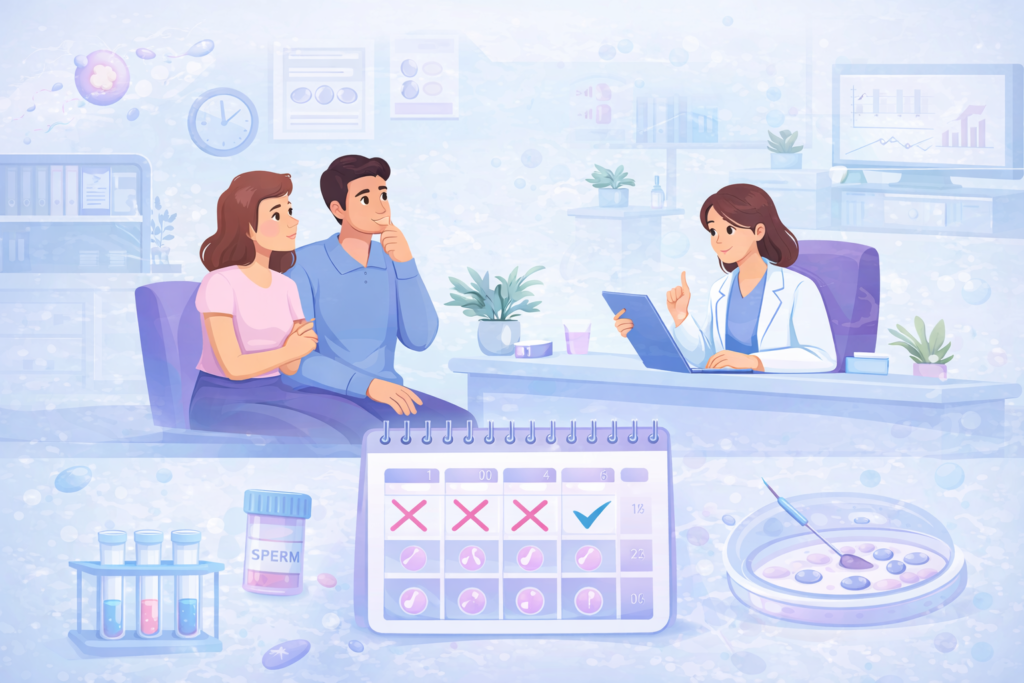
How many IVF cycles are needed ? It is difficult to predict how many IVF cycles a patient may need. IVF success depends on: >> Age of the female partner >> Egg reserve >> Sperm quality >> Embryo quality >> Presence of uterine disease >> Endometrial thickness and health Hidden Factors Affecting IVF Success Some factors cannot be detected during routine pre-IVF testing: ~> Altered endometrial receptivity ~> Genetic status of the embryo ~> Immunological causes of IVF failure Certain investigations are done only after IVF failure.All tests cannot be performed in advance Conditions Where More Than One IVF Cycle May Be Needed Embryo Pooling # Low ovarian reserve results in fewer eggs and embryos. # Multiple egg collections may be needed to pool good-quality blastocysts. Known Genetic Abnormalities # More embryos may be required for genetic screening (PGT). # This may need more than one stimulation cycle. Thin Endometrium # Lower success rates compared to normal endometrium. # May require additional treatment cycles. Important Notes for Patients >> Any patient may face IVF failure and require a second cycle. >> IVF failure should not be seen as a personal failure. >> Persistence and emotional strength are essential. “We don’t fail when we don’t achieve.We fail when we lose faith.”
What Are the Causes of Female Infertility? Symptoms, Diagnosis & Treatment

Female infertility causes are one of the most common concerns faced by couples trying to conceive. Today, nearly 1 in 6 couples experience difficulty getting pregnant. Because of this, many women are unaware of the underlying reasons until they undergo proper medical evaluation. For example, hormonal problems, ovulation issues, and blocked fallopian tubes are common causes of infertility. Moreover, early testing helps identify these problems before they become serious. Furthermore, timely treatment can greatly improve the chances of pregnancy. At Lavanya Fertility & Women Health Centre, Tirupati, we help women understand their fertility health with advanced diagnosis, personalised treatment, and supportive care. As a result, couples receive clear guidance and the right care at the right time. This guide explains the top female infertility causes, early symptoms to watch for, how doctors diagnose the condition, and the best available treatments. What Are the Female Infertility Causes? Female infertility is defined as the inability to conceive naturally after 12 months of regular, unprotected intercourse.For women above 35 years, evaluation is recommended after 6 months, as egg quality and ovarian reserve decline faster with age. Top Female Infertility Causes Female infertility can occur due to multiple medical, hormonal, anatomical, or lifestyle-related issues. The most common female infertility causes include: 1. Ovulation Problems (Irregular or No Ovulation). Irregular or absent ovulation is one of the leading female infertility causes, making it difficult for the ovaries to release a healthy egg each month. Leading causes of ovulation issues include: 1. PCOS (Polycystic Ovary Syndrome) – The #1 cause of ovulation disorder 2. Thyroid disorders (Hypothyroidism/Hyperthyroidism) 3. High prolactin levels 4. Underweight or obesity 5. High stress levels Common signs: irregular periods, excessive hair growth, acne, sudden weight gain, or very painful cycles. 2. Fallopian Tube Blockage – Common Female Infertility Cause Healthy fallopian tubes are essential for natural conception. When the tubes are blocked, the egg and sperm cannot meet, causing infertility. Main causes of tubal blockage: 1. Pelvic inflammatory disease (PID) 2. Previous abdominal or pelvic surgery 3. Tuberculosis infection 4. Endometriosis Early sign: severe period pain or painful intercourse. 3. Uterine Abnormalities as Female Infertility Causes The uterus must be healthy for embryo implantation. Structural problems can interfere with conception or cause repeated miscarriages. ~> Fibroids ~> Polyps ~> Uterine septum ~> Adenomyosis ~> Scar tissue (Asherman Syndrome) These can interfere with embryo implantation or cause repeated miscarriages. 4. Endometriosis – Increasingly Common Female Infertility Cause Endometriosis occurs when tissue similar to the uterine lining grows outside the uterus, contributing to several female infertility causes. How it affects fertility: ~> Causes blocked tubes ~> Affects egg health ~> Reduces ovarian reserve ~> Leads to inflammation in the pelvis Common symptoms: painful periods, heavy bleeding, pain during intercourse. 5. Age-Related Female Infertility Causes Age is one of the strongest factors that influence fertility. Women above 30 experience a gradual decline in both egg quantity and quality. Why age affects fertility: ~> Decline in number of eggs ~> Higher chances of chromosomal abnormalities ~> Lower fertilisation and implantation rates ~> Reduced embryo quality Women above 35 are advised to undergo timely fertility evaluation. 6. Lifestyle-Related Female Infertility Causes Everyday lifestyle habits play a major role in reproductive health. Many female infertility causes are linked to unhealthy routines. Factors that affect fertility: # Smoking or alcohol # High caffeine intake # Stress and lack of sleep # Poor diet & obesity # Lack of physical activity Common Symptoms of Female Infertility Not every woman shows symptoms, but some indicators include: >> Irregular or missed periods >> Very painful periods >> Heavy or scanty bleeding >> Pain during intercourse >> Unexplained weight gain >> Acne or excess facial hair >> Discharge or pelvic infections >> Repeated miscarriages If you notice these symptoms, it’s important to consult a fertility specialist early. How Is Female Infertility Diagnosed? At Lavanya Fertility & Women Health Centre, Tirupati, we follow a systematic, evidence-based approach: Blood Tests 0 AMH (egg reserve) 0 Thyroid profile 0 Hormone levels (FSH, LH, Prolactin) 0 Sugar profile & insulin resistance Ultrasound Scan To check ovaries, follicles, uterus, fibroids, cysts, lining thickness. HSG / SSG To check fallopian tube blockage. Advanced Pelvic Evaluation For endometriosis, adenomyosis, or hidden pelvic issues. Husband Semen Analysis Because 40% of fertility issues involve the male partner. Treatment Options for Female Infertility Treatment depends on age, cause of infertility, ovarian reserve, and duration of trying. Ovulation Induction Medicines to help release a healthy egg every month – ideal for PCOS or irregular periods. IUI (Intrauterine Insemination) Specially selected sperm is placed directly inside the uterus at the time of ovulation. Best for: mild PCOS, mild male factor, unexplained infertility. IVF (In Vitro Fertilisation) Egg and sperm are fertilised in a laboratory and healthy embryos are transferred. IVF is recommended for: ♦ Tubal blockage ♦ Severe endometriosis ♦ Low AMH ♦ Failed IUI ♦ Unexplained infertility Laparoscopic & Hysteroscopic Surgery Minimally invasive surgeries help treat: ♦ Fibroids ♦ Cysts ♦ Endometriosis ♦ Uterine septum ♦ Polyps Restoring normal fertility. Lifestyle & Diet Modification Essential for improving egg quality and hormonal balance. Why Choose Lavanya Fertility & Women Health Centre, Tirupati? ♦ Advanced fertility evaluation & treatment ♦ Experienced gynecologist & fertility specialists ♦ Laparoscopic and cosmetic gynecology experts ♦ Evidence-based treatment with transparent success rates ♦ Affordable fertility care in Tirupati ♦ Compassionate support throughout your parenthood journey Moreover, our clinic follows international fertility guidelines to ensure safe and effective care. Furthermore, we focus on personalised treatment plans based on each woman’s unique fertility needs. As a result, our patients receive the right treatment at the right time with complete transparency. Conclusion Female infertility is common, treatable, and manageable with early diagnosis. Most women conceive successfully with the right treatment plan. If you are trying to conceive without success, it’s important not to delay medical consultation. At Lavanya Fertility & Women Health Centre, Tirupati, we are dedicated to guiding you from diagnosis to successful pregnancy with personalised, ethical, and advanced fertility care.
Right Age for IVF of the Female Partner? | Lavanya Fertility Centre
Right Age for IVF – Why Timing Matters Age is the most important factor influencing the success of any fertility treatment, including IVF (In Vitro Fertilization).When a couple has a clear-cut indication for IVF treatment, it is advisable not to delay treatment unnecessarily, as fertility potential declines with age. Couples should plan their work commitments, time, finances, and family support in advance. However, in certain medical situations, IVF treatment should not be delayed at all to achieve better success rates. Situations Where Delay Should Be Avoided – Right Age for IVF IVF treatment should be considered at the earliest in the following conditions: 1. AMH Less Than 2 › AMH levels may decline rapidly. › Delay can compromise egg quantity and egg quality. 2. Endometriosis › Egg quality is often affected › Early IVF treatment offers better outcomes 3. Severe Male Factor Infertility › Younger oocytes have better corrective mechanisms › They can compensate for sperm-related issues more effectively Female Partner Approaching Advanced Age (≥35 Years) – Right Age for IVF › Embryos from older women have a higher risk of genetic abnormalities (aneuploidy) Age-wise Risk of Genetic Abnormalities in Pregnancy 25–29 years: 1 in 1100 pregnancies. 30–34 years: 1 in 700 pregnancies. 35 years: 1 in 200 pregnancies. 40 years: 1 in 60 pregnancies. It is always better to undergo IVF as early as possible when medically indicated, based on individual circumstances. 📞 Consultation & Appointment For personalized fertility evaluation and expert guidance, consult a fertility specialist to understand the right time for IVF based on your medical condition. 👉 Book a Consultation / Appointment
What is IVF and How Does It Work?

What is IVF? IVF means In Vitro Fertilization. It is a medical treatment that helps couples get pregnant when natural methods do not work. In IVF, doctors collect eggs from a woman’s ovaries and sperm from a man. Then, they combine them in a lab to form an embryo. After that, the embryo is placed into the woman’s uterus to help achieve pregnancy. In simple words, what is IVF?It is a way to help an egg and sperm meet outside the body. Later, the formed embryo is gently placed back into the womb. IVF is one of the most trusted fertility treatments worldwide. Moreover, it has helped millions of couples become parents. As a result, IVF gives hope to couples struggling with infertility. At Lavanya Fertility & Women Health Centre, Tirupati, we provide safe, ethical, and advanced IVF care with personal support at every step. Why Is IVF Needed? Many couples ask why IVF is needed. In most cases, IVF is advised when other treatments fail. For example, IVF may be recommended when: A woman has blocked fallopian tubes A woman has ovulation problems A man has low sperm count or poor sperm quality A woman has endometriosis A couple has unexplained infertility A woman has low egg reserve Previous fertility treatments have failed Because of this, IVF becomes a helpful option when natural pregnancy is difficult. What Is IVF Step by Step? To understand what is IVF clearly, let us see each step. 1. Ovary Stimulation First : Medicines are given to help the ovaries produce more eggs then regular scans and blood tests are done to track egg growth. 2. Egg Collection Next : The eggs are collected from the ovaries using a small procedure usually this is done under light anesthesia. 3. Sperm Collection At the same time, a sperm sample is taken from the male partner then healthy sperm are selected in the lab. 4. Fertilization After that eggs and sperm are combined in the lab as a result fertilization occurs, and embryos are formed. 5. Embryo Development Meanwhile embryos are kept in a special incubator for a few days. During this time, doctors monitor their growth. 6. Embryo Transfer Finally, one healthy embryo is placed into the uterus. Afterwards, medicines are given to support pregnancy What Is IVF Success Rate? Many people worry about success.However, IVF success depends on several factors. For example, success depends on: >> Age of the woman >> Egg quality >> Sperm quality >> Uterus health >> Lifestyle habits In general, younger women have higher success rates.Therefore, early treatment improves outcomes. At Lavanya Fertility Centre, Tirupati, we guide couples honestly about their chances. What Is IVF Like for Patients? Many couples fear IVF. However most steps are simple and safe. Usually women feel mild pain or bloating during treatment. Meanwhile emotional support is also very important. Because of this, our team offers counseling and personal care. What Is IVF vs Natural Pregnancy? People often compare IVF with natural pregnancy. In natural pregnancy, fertilization happens inside the body. On the other hand, in IVF, fertilization happens in a lab. Still, the final pregnancy process is the same. Therefore, IVF babies are as healthy as naturally conceived babies. Who Can Benefit from IVF? IVF can help many people. For example, IVF helps: Married couples with infertility Women with low egg reserve Men with low sperm count Couples with repeated pregnancy loss Women above 35 years Moreover, IVF is useful for couples who want genetic testing. Is IVF Safe? Many patients ask if IVF is safe. The good news is, IVF is very safe when done properly in addition, modern technology has reduced risks. However, like all treatments, IVF has small risks. Therefore expert care is important. Why Choose Lavanya Fertility & Women Health Centre, Tirupati? Advanced IVF lab and technology Experienced fertility specialists Ethical and transparent treatment Affordable IVF packages High success rates Personal and emotional support Moreover, we follow international fertility standards.As a result, couples receive safe and trusted care. Conclusion Now you clearly know what is IVF and how it works. In short, IVF is a powerful fertility treatment that helps couples get pregnant.Moreover, it offers hope when other methods fail.Because of this, early consultation improves success. At Lavanya Fertility & Women Health Centre, Tirupati, we are dedicated to helping you become parents with compassion and care. FAQs – What Is IVF? 1. What is IVF in simple words? IVF is a treatment where eggs and sperm are joined in a lab to form a baby. 2. Is IVF painful? IVF causes mild discomfort but is mostly painless. 3. How long does IVF take? One IVF cycle takes about 4–6 weeks. 4. Is IVF 100% successful? No. Success depends on age, egg quality, and health. 5. Is IVF safe for babies? Yes. IVF babies are as healthy as natural babies.